Wednesday, September 30, 2009

Biodynamic Seed-propagation


On July 11th we where invited-to the open Seed- day at “Fintan” the 140 Ha Farm in Rheinau, the largest Biodynamic Farm in Switzerland.
Since over 25 Years farmers and researchers have been involved in developing seeds appropriate to Biodynamic and organic farming methods. Quite a number of vegetable seeds and cereals have by now been registered and made available since.
It takes thousands of seed trials and about 15 years until an acceptable variety of cereal is produced, an effort which can only be carried by subsidies and donations.
With the rapid disappearance of a large diversity of seed-stocks (and animal breeds as well) and the concentration of seed-propagation in the hands of a few powerful multinationals and lately the development of GMO seeds this work has become crucial for the future of humanity. Conventionally available seeds are not appropriate for sustainable farming methods, the only give results with high fertilizer inputs, herbicides and pesticides, and in general can not be propagated by the farmer, so that he has to buy new seed every year.
As a Banana grower I regret not to be able to work on seed propagation, the development of new Banana varieties is extremely difficult and costly, the Banana industry relies on the only one marketable Cavendish variety, which is propagated since over 30 years vegetabily and becomes increasingly susceptible to diseases. In Biodynamics we know that plants are cosmically rejuvenated by going through a flowering and seed-process.
We are glad to be able to contribute to this effort at least financially, apparently this seems to be typical for older people to be concerned about the future, it is the old farmer planting apple trees even if he does know that he will not be the beneficiary of the fruits, in that category also fits seed-propagation and the caring for the future of children. It could also be said that believing in re-incarnation this may not be all that altruistic as it seems!
http://08.avenirsem.ch http://gz.peter-kunz.ch http://www.sativa-rheinau.ch http://www.turtletreeseed.com

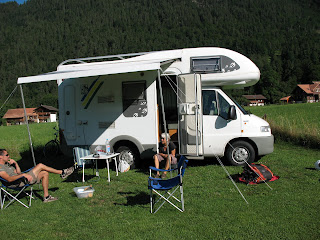
Our home on wheels in Europe.


Since several years we are fortunate to spend a few month in Europe in order to escape the peak caribbean heat.
Our home there is a “camping car”, the kind of ugly white plastic box cluttering the most scenic tourist sites that we in the past we used to look at with disdain!
However, after initially having rented one we learned to appreciate its convenience, and eventually bought one ourselves, and when not in use it is parked in Switzerland, with our son Sebastian (who has abandoned farming and is now making a living giving tourists paragliding flights) in Interlaken.
On a relatively small space it has all the conveniences, sleeps 4, can be heated, has a mini-bathroom with toilet, sink and douche, a 4 pit gas-range and refrigerator. There is enough space to store paraglider, inflatable canoe and our bicycles which are great for sightseeing and entering towns for shopping!
Traveling longer distances is now a pleasure, after a few hours driving we pull of the road take a coffee brake, often cook lunch (Annelien!) and take a nap. Overnight we often park between farm fields, the edge of the woods or along a stream, and if we get caught in an urban area we look for a quite parking spot often found next to a church, or a sport field, and in France and Italy most towns have a designated parking area for camping cars. Often when parked for the night close to roads, other campers park alongside feeling more secure in company.
Whenever we decide to stay longer or when it is time to do laundry we check in to a campground.
Visiting relatives and friends is easy, nobody has to be inconvenienced, we are simply temporary neighbors, can be grandparents and retire to our own quarters if the kids get to rowdy!
Business visits are uncomplicated, if Annelien has her fill of seeing one more cold-storage with Bananas she can simply stay at “home” in the parking lot, knit socks, read and sometimes join again for a business lunch.
Escaping unpleasant weather, especially in Switzerland is often (to) easy, it takes about three hours to cross the alps to the italian sunny side, a temptation which tends to bring some undesirable restlessness if not checked.
The planning of our itinerary has the following pattern: Family and friends, Banana customers, Paragliding sites (usually in mountainous areas) and Biodynamic Farms, where sometimes also our help is welcomed!
After a few months however we are getting our fill of restlessness and look forward to our quiet home and a regular working schedule.

Monday, March 30, 2009

A permanent home for our Kindergarten.

After 4 years of housing our Kindergarten in various temporary rooms on our Finca, we now succeeded to give it its own 390 m2 home, consisting of two classrooms for 25 children each on the first floor and a 3 room teacher apartment on the second floor.
We where very fortunate to have found 2 trained Waldorf kindergarten teachers, from Colombia and Peru with 2 local assistants in training. We hope that with this step we can give Waldorf education a significant boost in our country, creating a space for internships and conferences.
On March 10 we where able to accept the second group of 26 children aged 3 ½ to 4 years old and move them in to new building, and on the first day of spring, March 21 we celebrated the inauguration with parents, coworkers and many friends.
The construction costs for the building of US$80,000 was mainly raised through a “Fair Trade” initiative of our client “Weiling” a organic food distributor in Germany, where banana customers where willing to pay a additional premium of US$0.01 per banana, as well as by the contribution of our Export company.
We separated a 7'000 m2 lot from our Finca and conveyed it to our Fundacion Nuestro Porvenir, the legal carrier of our Educational initiative, enough space to develop a full school.
After much deliberation we found that the Kindergarten needed a protected and sheltered area (this is already implicit in its naming, garden has its root in “guard” a guarded and protected area where valuable crops and flowers are tended with special care). Placing the Kindergarten close the center of our commercial operations appeared to be the best solution, it gives it the necessary protection from noise (nearly unbearable in the villages with unmuffled motorcycles and perpetual disco music) and burglars. It creates efficiencies in sharing some infrastructure and the availability of a helping hand of company staff is often of great help to the Kindergarten teachers. This nearness and presence of small children who need our help as well as the not for profit activity radiates a very positive social influence on our work.
It is very satisfying for me personally to be able to develop a educational initiative supported by our commercial activity, a reversal of the past where I have been farming inside the economic shelter of tax exempt educational foundations. As we have reached conventional “retirement” age I am happy do devote myself increasingly to cultural / educational activities, a privilege which is rare in our modern society, and I enjoy being called abuelito (little grandfather) in an environment where I am respectfully adressed “Don or Señor”. And my wife Annelien has renewed her mothering instincts creating a variety of dolls and animals. Small children and old people have a special affinity to each other, both are close to the spiritual world, the former fresh arrivals, the later mature departures.

Kindergarten inauguration


Tuesday, September 30, 2008

On our latest global financial crisis

The present crisis (as many before) has its main root in the Mortgage system and the reckless extension of credit based on property values, independently of the ability of the borrower to service that mortgage.

And obviously, with increasing world population and the impossibility of increasing the available land area this would seem to be a reasonable risk, except that these values periodically experience speculative overvaluation and one then speaks of a “burst bubble”.

This points to one of the capitalistic systems fundamental shortcomings, namely the treatment of land as if it were a commodity. It is the root of one of the gravest injustices, namely that owners of land can extract tribute of those who have no ownership, therefore enriching themselves without any economic counter-prestation.

This tribute is most visible in the real estate sector, but also paid by society as a whole, the cost is invisibly included in all our products, beginning in the cost of agricultural land, of land to build factories and businesses etc. etc. These “costs” or tributes always have to be calculated in to the price of goods and eventually land in the hands of the few who have title to the land.

In my work as a farmer I am confronted with this problem, especially in the Dominican Republic where land prices have increased the last 15 years about tenfold, caused by peoples lack of confidence in the banking system but also for tor a major part by the laundering of money of corrupt government officials and the drug trade. It is also here not possible anymore to purchase land and to pay for it by agricultural production (that is to say that those costs can not be included in the price of Bananas anymore).

All material goods for our use are produced by labour, even be it minimal such as the harvesting and bringing to market of wild berries. However land and mineral deposits (such as oil) have not been created by man and should therefore be considered a fundamental right of all mankind.

The land ownership issue is at the cause of many wars and rebellions especially in poor countries. Many socio-economic thinkers have pointed to that fact that land is a right and not a commodity to be sold and bought.
Rudolf Steiner in his socio-economic lectures called the treatment of land as a commodity a cancer in our economic system; excess money is diverted and held back in land instead of productively invested in culture, research and education. (One should imagine what it would have meant mean if all the billions which are being lost by the present crisis would have been invested in Education!).
Steiner pointed out that every person incarnated on this earth should have the fundamental right to an area of land, to be determined by the available land area divided by the number of people.

In today's society obviously not everybody wants to work his “own” land and so makes his land available to those who make productive use of it. Any user of land, be it a farmer, industrial or house owner has to have the right to use the land exclusively with full control over it, however this has to be a temporary right , which when he does discontinue its use will be passed on to others for productive use.

Presently there is a interesting initiative going on in Germany, launched by Goetz Rehn, owner of the largest pharmacy chain in Europe.
He advocates a guaranteed minimum income for every citizen, and there are initiatives who would like to see this scheme financed by the taxation of real estate property values. www.unternimm-die-zukunft.de www.basicincome.org

Thursday, May 15, 2008

Finding a Successor

The passing on of a business, especially a farming operation to the next generation is always a delicate and critical endeavour.
The transition to a new leader has to made considering his/her qualifications and not on purchasing power. Although I own a majority of shares in our farming and export company, I do not consider a business as an a asset to be sold like a commodity, but rather as a social organism with in which a very large number of people are involved.

Some calculations will give a picture of the magnitude of that involvement:
There are around 100 persons working in the company, and some 200 farmers supply us with their produce. We can safely assume that each of these 300 persons have an average of 8 dependants, so that we are talking of at least 2,400 persons covering their daily material needs directly through our activity.
In addition to that we should not forget our local merchants, suppliers of services and industrial goods. Extending the chain we are linked with shippers, traders, wholesale distributors and retail stores ending with the main persons for which we in the end all work: the Consumer !
We produce besides various other products, an average of 105,000 Kg Bananas per week all year round. Assuming that the average buyer consumes 0.4kg bananas per week we are talking about serving 262,500 consumers! I see this whole process as an economically interwoven and interdependent fabric, a positive part inside the global economy.

When asked if there is some successor in sight I like to joke that he/she is still being formed in our Kindergarten. Obviously I do not have another 20 years before retiring and realize that it is time to search more actively for someone to take over, finding the right person however is not an easy task.
Our daily business operation is completely managed by our long established local administrating staff, all of them also shareholders of the company.
Although they certainly could continue operating without me, in the long term this could be questionable without a leadership having some of the specific elements I have been able to contribute.

The person we are looking for should have the following qualities:
A philosophical grounding in Anthroposophy, specifically in Biodynamic agriculture and socio-economic “Threefold” concepts.
Other important factors are:
* Leadership and social abilities, farming and technical skills, a sense for business management and understanding of international (organic) markets.
* A affinity for latin culture, self-sufficiency and much tolerance and ability to live in a rather culturally undeveloped “third world country”, (for some time that may have its romantic charm).

I am confident and hopeful that eventually the right person will be found and that our endeavour is destined to continue, and maybe this blog may be the vehicle to that end !

Friday, May 9, 2008

The end of cheap food.

Already 80 years ago Rudolf Steiner and Albert Howard, the pioneers of Biodynamic / Organic Agriculture foresaw the disastrous effects Industrial manufacturing approaches to agriculture would have.
11 years ago the World Food Summit issued the “Declaration of Rome” with urgent warnings and recommendations regarding the future food supply.
The powers in charge turned a blind eye at such warnings, because they called for uncomfortable attitude changes.

Since the times of Adam Smith a fundamentally flawed “Capitalistic” ideology has emerged, namely that “monetary profit” should be the primary goal of economic activity instead of providing the material necessities of man.
The socialists where aware of this and developed a equally flawed “communistic” ideology.
The underlying cause of such ideologies is the result of the limitations of materialistic thinking.
This approach resulted in a tremendous boost in industrially produced goods, however, when applied to non industrial goods such as agriculture, education and healthcare they had the disastrous results under which we suffer nowadays.
The industrial approach to farming with external inputs increased volume production, with a serious decline life-quality of foods produced, as well as the destruction of natural soil fertility.
On the social level; especially after the opening of the american West and the global trade with cheaply produced grains caused the decline of farm-prices in Europe forcing impoverished farmers of the land into the slavery of factory work and this phenomena is unabatedly continuing today.

The availability of cheap food for the urban centres has been a priority of all governments, and we can see today a global panic fearing food shortages and mass rioting.

I have no doubt that Biodynamic Agriculture can feed a much larger world population than we have now.
The obstacles however are enormous, we would have to change many of our habits, decrease our excess protein consumption (meat), desist of driving our cars with bio-fuels and most difficult of all, is to create incentives for people to stay or even return to farming.

In any case the times of cheap food are gone, it should never have been cheap to begin with, which would have avoided the suffering we are going to face now.